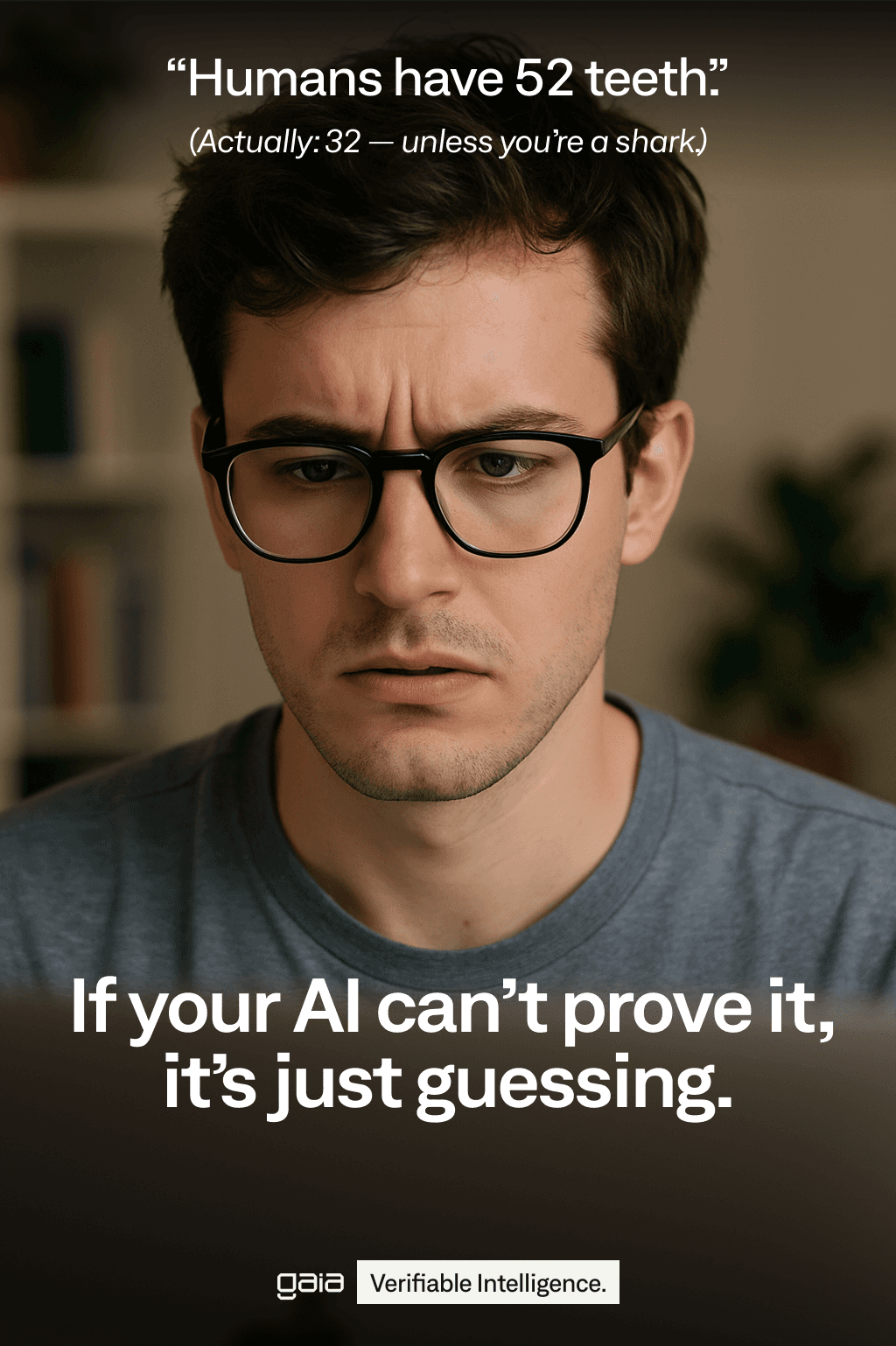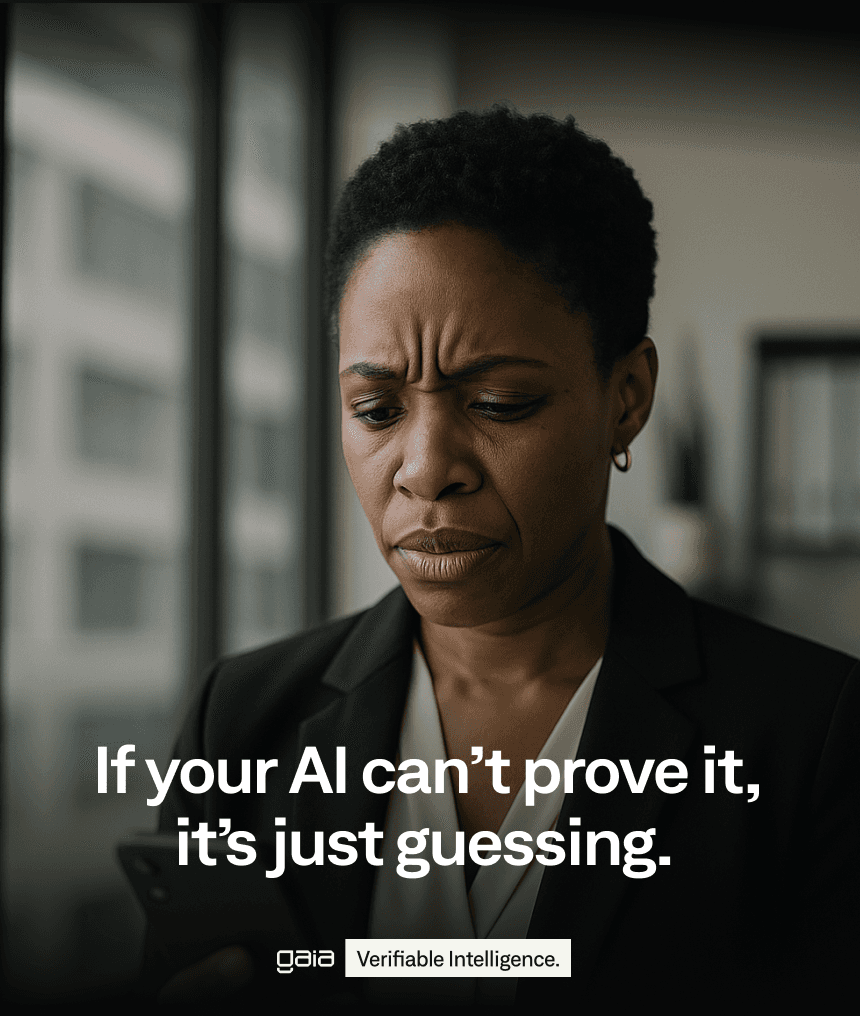
As AI adoption accelerated, accuracy quietly became optional. Large language models were increasingly treated as authoritative—despite their tendency to hallucinate, fabricate facts, and present uncertainty with confidence. In an industry obsessed with speed and novelty, very few teams were asking a more uncomfortable question: How do you actually trust an AI output? At Gaia, we believed the next phase of AI wouldn’t be defined by better answers—but by provable ones. The Verifiable Intelligence campaign was created to introduce that idea in a way that felt immediate, human, and impossible to ignore.
Problem
“AI hallucinations” had become normalized.
Users were aware that AI made mistakes, but the industry largely treated those failures as edge cases or punchlines—not systemic problems. From a marketing standpoint, the challenge was to confront that complacency without sounding alarmist or overly technical.
We needed to:
Make AI failure relatable, not abstract
Break through AI hype with simplicity and restraint
Communicate a complex infrastructure concept in seconds
Position Gaia as a category definer, not a feature competitor
Most importantly, the message had to land instantly—before anyone clicked a link or read an explanation.
Outcome
The insight was simple: everyone has already experienced AI being wrong.
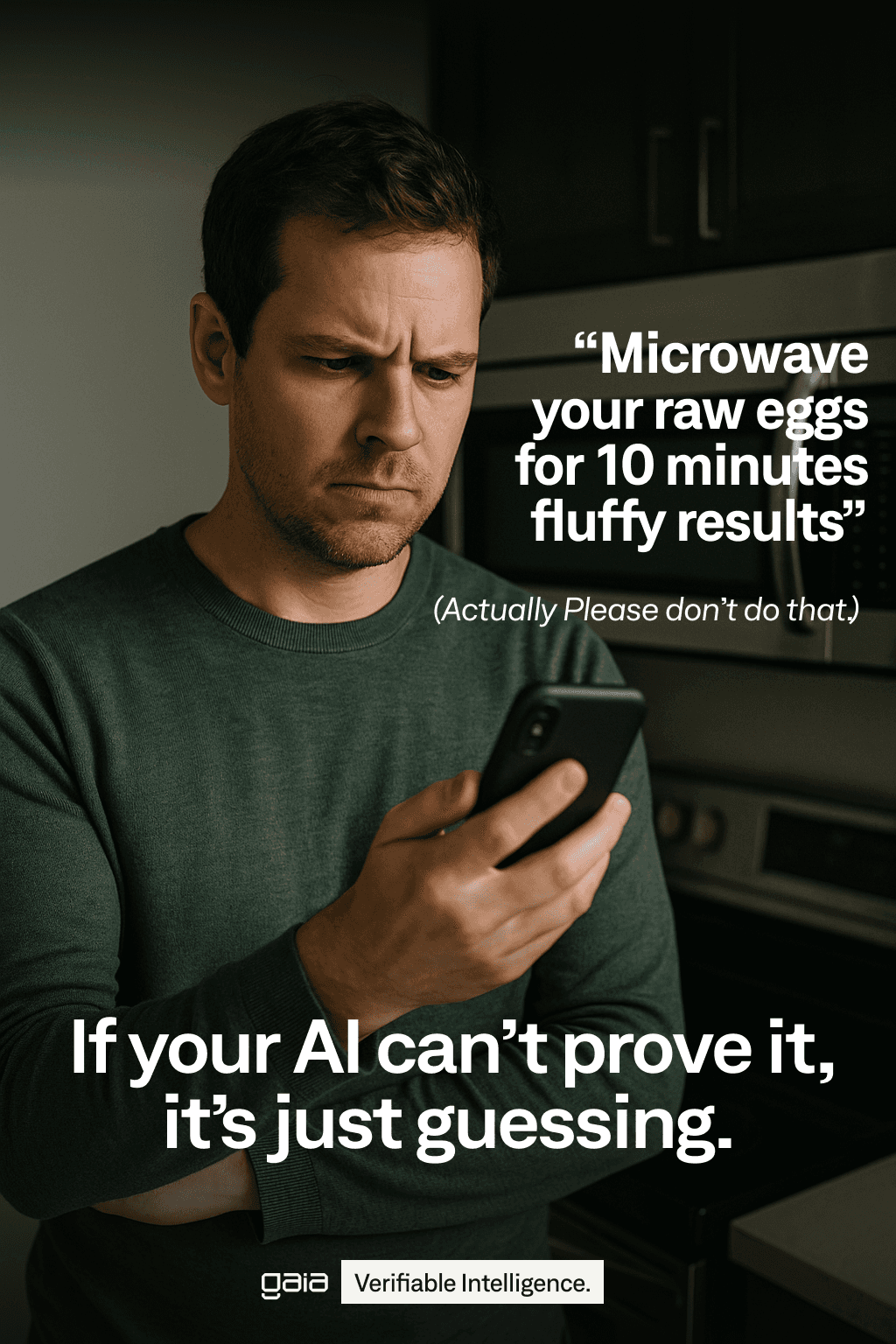
Rather than explaining verification through diagrams or whitepapers, we anchored the campaign in familiar moments—confident statements that are subtly, obviously incorrect. The tension between certainty and truth did the work for us.
“If your AI can’t prove it, it’s just guessing.”
That line reframed the problem. Accuracy wasn’t a bug. It was a missing system.
By pairing everyday hallucinations with calm, understated visuals, the campaign invited viewers to question AI outputs the same way they question unverified information anywhere else.